
The Iowa probate timeline shapes every decision you’ll face as an out-of-state heir. When a parent dies and leaves you a house in Iowa — and you live in Phoenix, or Chicago, or anywhere that isn’t Des Moines — the first question is almost always the same: “How fast can I sell it?” It’s a fair question, and an urgent one.
You may be managing the property remotely, paying to keep the lights on, and watching an empty house age through an Iowa winter. But here’s the reality most out-of-state heirs don’t learn until they’re already in it: in Iowa, you usually can’t sell an inherited home the moment you decide to. The probate timeline controls when you have the legal authority to list, sign, and close — and that timeline runs on its own clock.
I’m Sarah Ingles, a REALTOR® with the SRES® (Seniors Real Estate Specialist) designation and the CPCU® (Chartered Property Casualty Underwriter) credential, and a practice built around senior, probate, and out-of-state transactions across Polk, Dallas, and Warren Counties.
Most of the heirs I work with have never been through probate before — and they’re trying to manage it from hundreds of miles away. This post walks through the Iowa probate timeline as it actually affects your ability to sell, so you know which steps gate the sale and where the expensive surprises hide.
What has to happen before you can legally sell an inherited Iowa home?
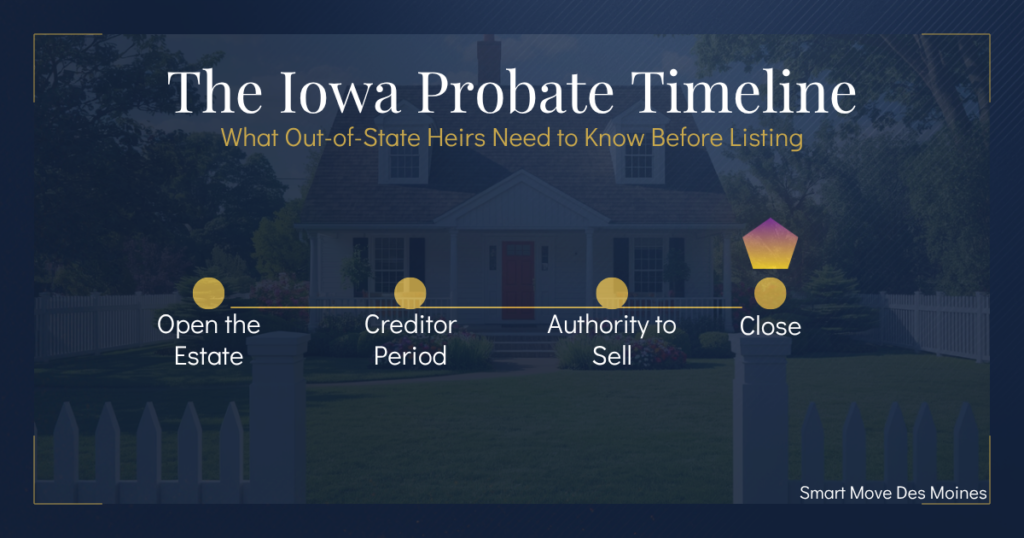
The Iowa probate timeline begins here.Before a house can be listed and sold, the estate generally needs to be opened in the Iowa county where the property sits, and someone needs the legal authority to act on the estate’s behalf. That authority comes from the court — not from being named in the will.
In practical terms, that means the will (if there is one) is filed with the county Clerk of Court, and the court appoints a personal representative — issuing what’s called Letters Testamentary when there’s a will, or Letters of Administration when there isn’t. Until those letters are issued, no one has the authority to sign a listing agreement or transfer the property. For an out-of-state heir, this is the first place the timeline stalls: you can’t act on momentum and good intentions alone, and you can’t shortcut the appointment by being the obvious heir. The court has to grant the authority first. This is also why your very first call should be to an Iowa probate attorney, not a real estate agent — the legal authority has to exist before the real estate work can begin.
How long does probate take in Iowa before you can sell?
Most Iowa estates take several months to administer, and many take six to twelve months from opening to closing — though the time to reach the point where you can sell is often shorter than the time to fully close the estate.
The single biggest driver of the timeline is the creditor claim period. After the estate is opened and notice is published, Iowa law provides a window during which creditors can file claims against the estate. That period runs for months, and it exists to protect both creditors and heirs — it ensures debts are addressed before assets are distributed. The practical effect for you: even once you have authority and a buyer, the estate’s obligations have to be accounted for. Whether you can close a sale before the creditor period fully runs depends on how your estate is being administered and what your attorney advises. This is exactly the kind of timing question your Iowa probate attorney maps for your specific situation — and why “how fast can I sell?” rarely has a one-size answer.
What’s the difference between independent and supervised administration — and why does it matter to an heir?
Iowa allows estates to be administered in different ways, and which path your estate takes meaningfully affects how much court involvement each step requires — including the sale of real property.
In broad terms, a more independent administration gives the personal representative more latitude to act without seeking court approval at each step, which can make selling real estate more straightforward.
A supervised administration involves more court oversight, which can add steps and time to a sale. You won’t choose this in a vacuum — your attorney recommends the path based on the will, the heirs, and the complexity of the estate. But it’s worth understanding as an heir, because it explains why two probate sales in the same county can move at very different speeds. When someone tells you “my friend sold their parent’s house in three months and mine is taking eight,” the administration path is often part of the answer.
Why does the timeline create insurance and carrying-cost risk for out-of-state heirs?
Because while the Iowa probate timeline runs, the house sits empty — and an empty house is where the quiet, expensive problems accumulate.

This is the part I see heirs underestimate most, and it’s where my property insurance background changes how I look at a file. A standard homeowners policy is written for an occupied home. Once a house sits vacant — often after just 30 to 60 days, depending on the carrier — vacancy provisions can narrow or restrict coverage for exactly the risks an empty house faces: a burst pipe, water damage, vandalism. If a pipe fails in February in a vacant Des Moines home and the policy has already lapsed into a vacancy exclusion, the estate can be left paying for the damage out of pocket.
The probate timeline and the insurance clock are running at the same time, and they don’t wait for each other. For an out-of-state heir who can’t drive by to check on the property, this gap is both more likely and more costly. (I’ve put the full breakdown of this in a separate guide — linked at the end — because it’s the single most preventable loss I see in inherited Iowa property.)
What should an out-of-state heir do first, before worrying about listing?
Start with authority and protection, not the listing. The sale is the last step, not the first.
In the first weeks, the highest-value moves are: engage an Iowa probate attorney to open the estate and establish your authority to act; secure and protect the property (locks, utilities, and a local point of contact for an empty house you can’t visit); and contact the existing insurance carrier immediately to understand the vacancy provisions before they bite.
Once authority is established and the property is protected, then the real estate decisions — pricing, timing, listing — come into focus. Trying to reverse that order is what leaves heirs paying carrying costs on a house they don’t yet have the authority to sell. As a Chartered Property Casualty Underwriter, the insurance step is the one I’ll always flag first, because it’s the cheapest to fix and the most expensive to ignore.
FAQ
How soon after my parent’s death can I sell their Iowa house? Not immediately. You first need the estate opened in the Iowa county where the property is located and court-granted authority to act — Letters Testamentary (with a will) or Letters of Administration (without one). Until that authority is issued, no one can legally sign a listing or transfer the home. Timing from there depends on your estate’s administration path and your attorney’s guidance.
Do I have to travel to Iowa to handle the probate sale? Usually not for the entire process. Much of the legal and real estate coordination can be handled remotely with the right team — an Iowa probate attorney, a closing/title office, and an agent experienced with out-of-state heirs. You’ll want a local point of contact for property checks on a vacant home, and you should ask your attorney early whether remote notarization is available for any documents.
Why does the inherited house need different insurance during probate? Standard homeowners policies are written for occupied homes. Once a property sits vacant — often after 30 to 60 days, depending on the carrier — vacancy provisions can narrow or exclude coverage for risks like burst pipes, water damage, and vandalism. During the months a probate timeline runs, that gap can leave the estate exposed to losses it expected to be covered.
How long does the Iowa probate process usually take? Many Iowa estates take roughly six to twelve months from opening to closing, driven largely by the creditor claim period that follows opening the estate. The point at which you can sell may come sooner than full closure, but it depends on your estate’s administration and your attorney’s advice. There’s no single fixed number — the path the estate takes matters.
Who should I call first — a realtor or an attorney? An Iowa probate attorney first. The legal authority to act on the estate has to be established before any real estate work can happen. Once your attorney has opened the estate and the property is secured and properly insured, that’s the right time to bring in an agent experienced with probate and out-of-state heirs to handle the sale.
Let’s Talk
When you’re ready to talk through your specific situation — multiple heirs, a vacant property, probate timing pressure, or an out-of-state estate — I offer a free, no-pressure 20-minute call. Honest read on where you are and what comes next.
Sarah Ingles, REALTOR® · SRES® · CPCU®
📞 (563) 513-8771
Book a 20-minute call at smartmovedsm.com/book
I’m not your insurance agent — but as a CPCU, I know what to look for and who to call.